Do You Own the AI Images You Make?
By Chatday Editorial Team ·
In 2023 a court in Beijing ordered a woman to pay 500 yuan, about 70 dollars, for reusing a picture called “Spring Breeze Brings Tenderness” as an illustration for her poems. The picture had been made with Stable Diffusion. The man who typed the prompts sued, and he won: the judge decided he was the author.
In the United States, an artist who fed one AI image generator more than 600 prompts to get his award-winning picture has spent years being told the opposite. Same kind of image, opposite answer.
If you make images with AI, for a logo, a book cover, a birthday invite or just for fun, you’ve probably wondered where you stand. The honest answer depends on what you did, where you live and what you want to do with the picture. Here are five things people believe that don’t quite hold up.
Myth 1: I typed the prompt, so the image is legally mine
Two very different things get mixed up here: what the app says, and what the law says.
The app part is usually friendly. OpenAI’s terms of use, for example, say that you own the output and that OpenAI assigns you “all our right, title, and interest, if any” in it. Anthropic’s terms use similar wording. Notice the two small words, “if any.” A company can only hand you rights that exist.
The law part is where it gets interesting. In the US, copyright only protects work made by a human. In January 2025 the US Copyright Office published a long report on AI and concluded that, with today’s tools, “prompts alone do not provide sufficient human control” to make you the author of what comes out. The Office’s comparison is that you’re like someone who commissions a painting. You described what you wanted. The machine decided the brushstrokes.
So the image is yours to use as far as the app is concerned. But in the US, an image that’s purely prompt-made usually has no copyright for anyone to own, you included.
Myth 2: No copyright means I can’t use it or sell it
This is the opposite mistake, and it scares people off for no reason.
Having no copyright doesn’t forbid you from doing anything. You can still post the image, print it on a mug or put it in your newsletter, as long as the tool’s terms allow it. What you lose is the power to stop other people. If someone grabs your AI picture and uses it on their own site, a US court is unlikely to help you, because there’s nothing protected to infringe.
There’s a second trap, and it runs the other way. An image you generated can still copy someone else’s work. If it looks like a famous cartoon character or carries a real brand’s logo, the problem isn’t your copyright, it’s theirs. That fight is already in court: Disney, Universal and Warner Bros. are suing Midjourney over images of their characters. As of late October 2026 that case is still in pretrial stages, with no ruling on the main question.
Myth 3: Write enough prompts and it becomes yours
It feels fair. If you spent a weekend on 600 prompts, surely you did the creative work.
Jason Allen made exactly that argument. His Midjourney image, Théâtre D’opéra Spatial, won first place in the emerging-artist category at the 2022 Colorado State Fair. The Copyright Office found that he had entered at least 624 prompts and still refused to register it unless he disclaimed the AI-made parts. He refused and sued. Both sides have filed their arguments with a federal court in Colorado, and as of mid-September 2026 no ruling had been reported.
The Beijing case went the other way because the judge looked at the same kind of effort differently. The creator had used around 30 prompts and more than 120 “negative prompts” (words telling the AI what to leave out), then kept adjusting them until the picture matched what he had in mind. The court treated that as real intellectual effort. Even there, though, it was a first-instance ruling that other Chinese courts don’t have to follow.
| Where you are | Does prompting alone make you the author? (October 2026) |
|---|---|
| United States | No, according to the Copyright Office. The courts haven’t yet ruled on heavy prompting (Allen’s case is pending). |
| China | One Beijing court said yes in 2023, based on detailed prompts and repeated tweaking. Other courts aren’t bound by it. |
| United Kingdom | The law has a special category for “computer-generated works” with 50 years of protection. In March 2026 the government said it plans to remove it, but no law has been passed yet. |
So the number of prompts isn’t the deciding factor. What matters is where you live and how much of the final picture actually came from your choices.
Myth 4: AI images can never be copyrighted
Also not true, and this is the part that’s actually useful.
Start with what’s settled in the US. When an AI makes something entirely on its own, nobody can copyright it. Stephen Thaler tried to register an artwork his AI system made with no human involved. He lost at every level, and on March 2, 2026 the Supreme Court declined to hear his appeal. Even so, the appeals court stressed that the rule doesn’t block work made with the help of AI. It just means the author has to be a person.
Then look at what has been registered. The comic Zarya of the Dawn kept its copyright for the writer’s text and for how the images were chosen and arranged on the pages, though the Midjourney images on their own were excluded. In January 2025 the Office registered A Single Piece of American Cheese, an image its creator built by regenerating selected parts of an AI picture 35 times. The protection covered the human selection and arrangement, not the raw AI pieces.
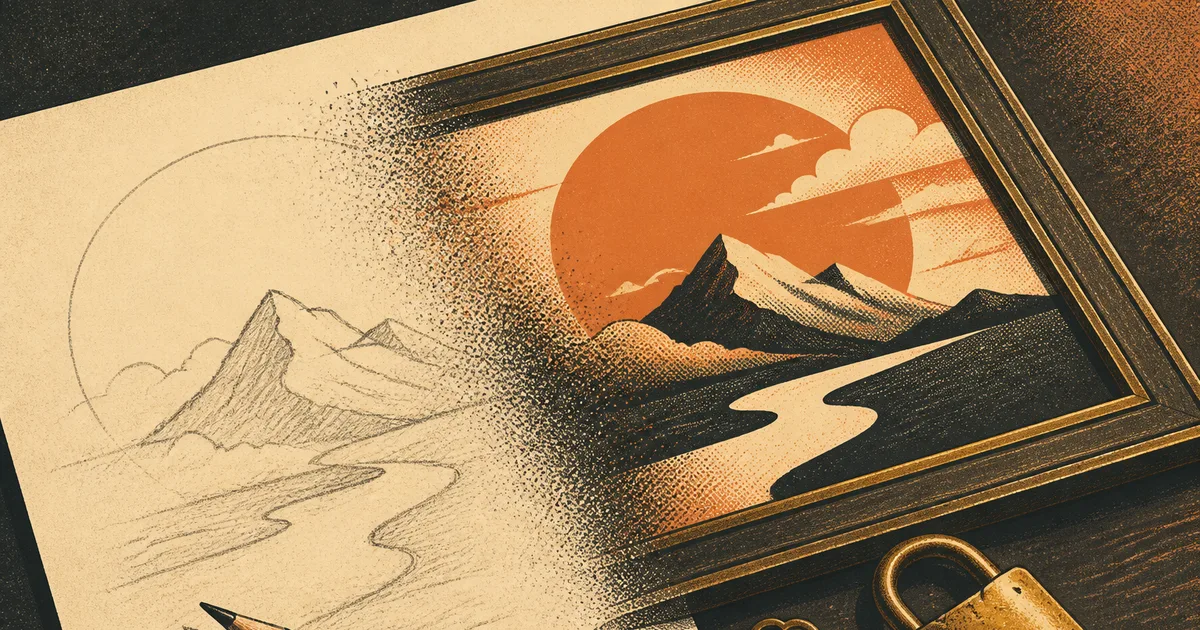
The Copyright Office’s 2025 report also gives you a door that most people miss. If you feed the AI something you made yourself, like a sketch or a photo, and your work is still visible in the result, your contribution can be protected.
| What you did | What US copyright covers |
|---|---|
| Typed a prompt, kept the result | Nothing, according to the Copyright Office |
| Typed hundreds of prompts and picked the best | Refused by the Office so far. The court case is pending |
| Combined AI images with your own text and layout | Your text and the arrangement, not the images |
| Edited an AI image region by region by hand | The selection and arrangement, with the AI parts excluded |
| Started from your own drawing or photo | The parts of your original that show in the result |
| An AI made it with no human involved | Nothing (Thaler, confirmed in 2026) |
Myth 5: It’s a gray area, so it doesn’t matter what I do
For a meme or a birthday card, it really doesn’t matter. Nobody is going to copy your party invite and sell it.
It matters more when the image is meant to last or to earn money. A logo, a mascot, a book cover or a character you want to build a shop around are the cases where someone copying it would hurt. That’s when how you made it starts to count. If you’re designing a brand mark, our guide on how to design a logo with AI pairs well with what follows.
A few habits put you in the strongest position, wherever you live:
- Start from something of yours. Your own sketch, photo or hand-drawn layout, then let the AI build on it.
- Keep editing. Change specific parts, combine pieces, add your own text and arrange the final layout yourself.
- Save your drafts. Earlier versions and notes on what you changed are the evidence of your human input. Commentators on the Thaler case give that same advice.
- Be upfront if you register it. The US Copyright Office expects you to disclose AI-generated material and explain what you contributed. The Zarya registration was cancelled and reissued because that step was skipped at first.
- Stay clear of other people’s characters and logos. That risk has nothing to do with whether your image can be protected.
Here’s a prompt to try that follows the first habit. Attach a photo of a rough sketch, even a bad one, and let the model do the polishing.
If you’re still choosing which model to make images with, our comparison of AI image generators goes through the options. The ownership rules above are the same whichever one you pick.