How to make AI writing sound human
By Chatday Editorial Team ·
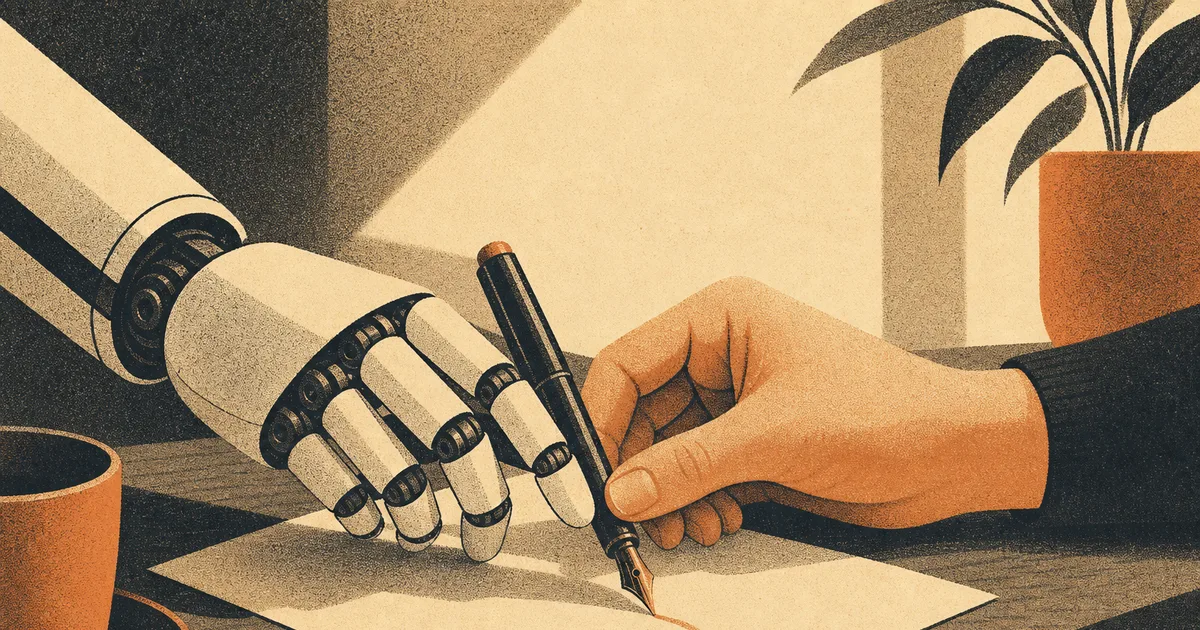
You’ve probably read something this week and thought, “a robot wrote that.” Maybe a LinkedIn post that opened with a rhetorical question. Maybe an email that called something a “game-changer.” Maybe a school essay stuffed with words nobody actually says out loud. AI can write a solid first draft in seconds, which is genuinely useful. The problem is that it tends to write in a very particular accent, and once you can hear it, you can’t unhear it. The good news: getting AI to sound like a real person, ideally like you, is mostly a matter of knowing the tells and asking for the right thing.
Why AI writing has a “tell”
AI models learned to write by reading an enormous pile of text, then getting nudged toward the kind of polished, agreeable, slightly formal tone that testers rated highly. The result is writing that is clean, confident, and weirdly uniform. It reaches for the same moves again and again, and those moves became a fingerprint.
Researchers have actually measured this. A Stanford team that analyzed close to a million scientific papers found that certain words, like “intricate,” “pivotal,” “showcasing” and “realm,” started showing up far more often after ChatGPT arrived, in some fields jumping into double-digit percentages of new papers. A separate analysis of medical articles found the word “delve” spiking dramatically after late 2022. None of these words are wrong. They’re just used at a rate no normal human hits, which is exactly why they stand out.
Then there’s the punctuation. The em dash, that long horizontal line, got so associated with chatbot text that people nicknamed it “the ChatGPT hyphen.” It got bad enough that in late 2025 OpenAI’s own CEO announced, as a small win, that ChatGPT would finally stop using em dashes when you ask it to. When a punctuation mark becomes a meme, you know the accent is real.
The giveaways, and what to do instead
Here’s the field guide. If your draft is doing the thing on the left, fix it with the thing on the right.
| The AI tell | Why it sounds robotic | What to do instead |
|---|---|---|
| ”It’s not just X, it’s Y” | A formula the model loves and humans rarely use | Just say the point once, plainly |
| ”From budgets to brainstorms, AI does it all” | The “from X to Y” sweep | Name one real example, not a tidy range |
| Rule-of-three lists (“fast, simple and powerful”) | Everything comes in neat trios | Use two items, or four, or an uneven sentence |
| Words like “delve,” “leverage,” “robust,” “seamless” | Nobody says these at dinner | Swap for the word you’d actually use |
| Opening with “In today’s fast-paced world…” | A throat-clearing intro that says nothing | Start with the actual point or a real moment |
| Every sentence the same medium length | Real writing has rhythm | Mix short punchy lines with longer ones |
| ”In conclusion, it’s important to note that…” | Filler that announces it’s about to speak | Cut it and just make the point |
You don’t need to memorize this. You mostly need to be able to feel it, and you can hand most of the work to the AI itself if you ask correctly.
Most of the fix is in the prompt
The single biggest reason AI writing sounds generic is that the request was generic. “Write a post about productivity” gives the model nothing to work with, so it falls back on its default accent. Give it context and the accent fades.
A good writing prompt answers four quick questions: who you are, who you’re writing to, what you want them to feel or do, and how long it should be. Tone words help a lot. “Warm but direct,” “a little funny,” “plain and human, no buzzwords,” “like a text to a smart friend.” You can also explicitly ban the tics.
It looks fussy, but banning the clichés out loud works surprisingly well, and you only have to write the prompt once. Save it and reuse it. If you’d rather not start from a blank box, Chatday’s help me write tool gives you a guided starting point for emails, posts and replies.
Give it your actual voice
This is the trick most people miss, and it’s the one that makes AI writing genuinely sound like you. Models are excellent mimics. If you show one a sample of how you write, it will copy your rhythm, your vocabulary, even your habit of starting sentences with “Honestly.”
Paste in two or three of your own messages, an old email, a couple of texts, a paragraph you’re proud of, and tell the AI: “Here’s how I write. Match this voice.” Suddenly the draft has your fingerprints instead of the factory default. This is also why the same request can feel robotic from one model and natural from another, since some are simply better mimics. If you’re curious which one writes most like a person, we put the big three head to head in our ChatGPT vs Gemini vs Claude comparison.
The 60-second human pass
Even a good draft deserves one quick edit, and this is where you turn “fine” into “sounds like a person wrote it.” You don’t need to rewrite. You need four small moves.
- Read it out loud. Your ear catches what your eye misses. Anywhere you stumble or roll your eyes, rewrite that line the way you’d actually say it.
- Hunt the tics. Search for “delve,” “leverage,” “seamless,” any em dash, and any “it’s not just” sentence. Kill them.
- Break the rhythm. If three sentences in a row are the same length, chop one in half. A short line lands harder.
- Add one specific detail. AI writes in safe generalities. One concrete thing (a real number, a name, a tiny story) is the fastest way to sound human, because the model would never have invented it.
That last point matters for a second reason. AI is a confident writer even when it’s wrong, so it will happily state things that aren’t true in a perfectly fluent sentence. If your draft makes a factual claim, check it. We dug into why this happens in why AI confidently makes things up. A quick grammar and clarity check catches the typos; only you can catch the made-up “fact.”
Which AI sounds the most human?
Honestly, all of the big models can write naturally now if you prompt them well, so the bigger lever is the prompt, not the brand. That said, they have personalities. Some default to crisp and businesslike, others to chatty and warm. The only way to know which one fits your voice is to give the same prompt to a few and read them side by side.
Try one paragraph in each, with your voice sample pasted in, and pick the one that needs the least editing. You can switch between them mid-conversation, so there’s no commitment.
A quick word on “AI detectors”
Because everyone can now smell AI writing, a wave of “AI detector” tools popped up promising to catch it. Treat their verdicts with heavy skepticism. They regularly flag human writing as AI (formal, careful writers get caught all the time) and miss genuine AI text, so a “score” from one of these is not proof of anything. The honest goal isn’t to beat a detector. It’s to write something clear and true that sounds like you. If a draft still reads stiff, an AI text humanizer can loosen it up, but your own read-aloud pass will usually do more.
The takeaway
AI is a fast, tireless first-draft writer, and that’s a real gift when you’re staring at an empty screen. It just has an accent. Once you know the tells, feed it your voice, and give the result a quick read-aloud before you send, the seams disappear and what’s left sounds like you on a good day. The tool does the heavy lifting; you do the part only a human can, which is sounding like one.