Why AI never gives the same answer twice
By Chatday Editorial Team ·
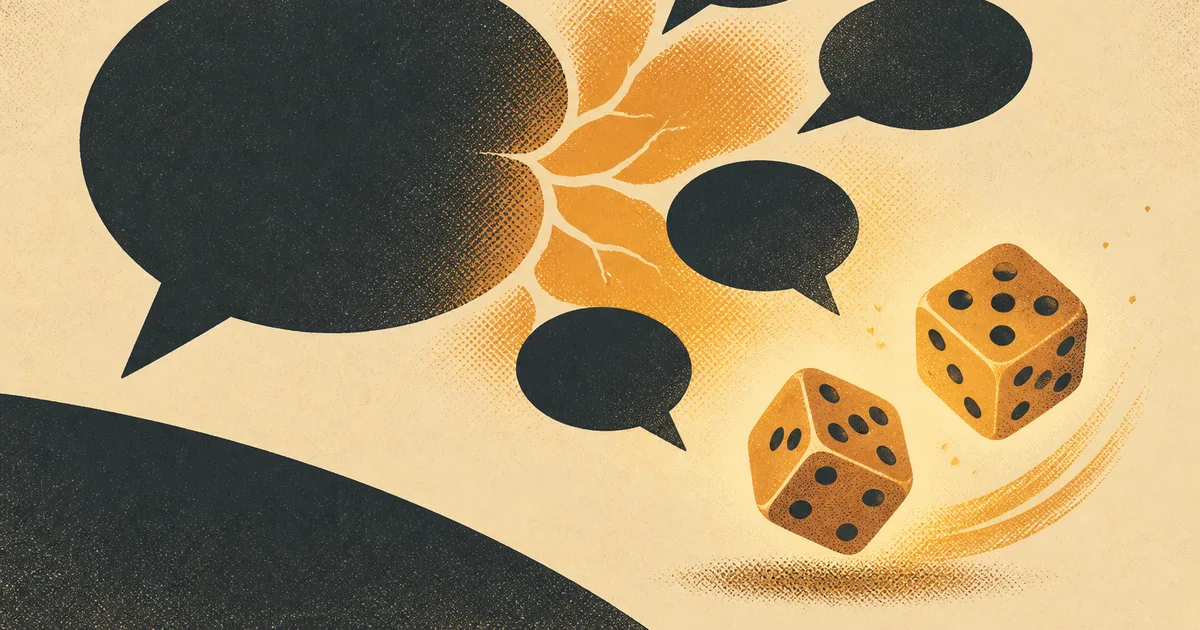
Try a tiny experiment. Open your favourite AI, ask it to write a birthday message for your mum, and read the reply. Now clear the chat and ask the exact same thing again, word for word. You will almost certainly get a different message. Maybe a warmer one, maybe a shorter one, maybe one that mentions a garden when the first talked about a cake.
Nothing broke. You did not phrase it differently. The AI just does not repeat itself, and that is by design.
Once you know why, that little quirk stops being annoying and starts being one of the most useful things about chatting with AI.
The one-word-at-a-time machine
Here is the thing most people never get told about AI chatbots. They do not write a whole answer and hand it to you. They build it one word at a time, guessing the next word over and over until the reply is done.
Think of the world’s best autocomplete. You type “thanks for the,” and your phone suggests “message,” “gift,” or “help.” An AI does the same, just far better and across a whole essay. At every single step it looks at everything so far and asks: what word most likely comes next?
The trick is that it does not just grab the single most likely word every time. It has a short list of good options, each with a rough chance attached, and it rolls a little dice to pick one. That dice roll is where the variety comes from. Pick a slightly different word early on, and the whole reply moves somewhere new from there.
Meet the “temperature” dial
That dice roll has a control knob, and it has a name you will start seeing everywhere: temperature.
Temperature decides how much the AI is allowed to gamble on less obvious words. It is usually a number between 0 and about 2, and you can picture it like this.
| Temperature | What the AI does | Feels like |
|---|---|---|
| Low (near 0) | Almost always picks the single most likely word | Careful, repetitive, “just the facts” |
| Medium (around 0.7) | Mixes safe picks with the occasional surprise | Natural, human, a good default |
| High (1.5 and up) | Happily reaches for unlikely words | Very creative, sometimes odd |
Most chat apps quietly set a medium temperature for you, because that is the spot where AI sounds like a person instead of a form letter. Turn it up and it gets bold and surprising. Turn it down and it plays it safe, saying almost the same thing every time.
You rarely touch this dial yourself in a normal chat. But it is running under the hood of every reply, and it is the main reason your birthday message came out differently the second time.
So why not just turn the randomness off?
Fair question. If you set temperature to zero, the AI should pick the most likely word every time and give you the same answer twice, right?
Mostly, yes. But not always, and the reason is surprisingly ordinary.
These models are enormous, and they run on huge banks of specialised computer chips that serve thousands of people at the same time. To keep up, the system groups requests together, splits the maths across many chips, and changes its setup often. Tiny differences in how and where those calculations happen can tip a word choice on the fine line between two almost equally likely words. Change one word, and again, the rest of the answer can follow.
So a chatbot is not a calculator with one correct output waiting inside. It is closer to asking a knowledgeable friend the same question on two different days. The main idea stays the same. The exact words change.
This is a different thing from why two different AIs give you different takes on the same question. If you have noticed GPT, Gemini and Claude disagree with each other, that is about how each one was built and trained. We pulled that apart in why AI models give you different answers. Today’s puzzle is smaller and stranger: the same model, changing its mind with itself.
When the variety works against you
Freshness is great for a birthday message. It is less great when you needed a fact.
Because the AI is reaching for plausible next words, asking again can occasionally swap a correct detail for a wrong one that sounds just as convincing, a made-up date, a book that does not exist, a confident number with nothing behind it. That is the same habit that makes AI confidently make things up, and the randomness can bring it out.
So treat the two jobs differently:
- Creative or open-ended (messages, brainstorms, names, first drafts): variety is your friend. Generate a few and pick the best.
- Facts and specifics (dates, quotes, medical or legal points, anything you will act on): do not trust a single confident reply. Ask again, ask it to double-check itself, and verify anything important against a real source.
Turn the quirk into a superpower
Once you stop expecting a single “official” answer, a better habit takes over. The first reply is a draft, not a final verdict.
Two moves get you a lot:
Just ask again. If a reply is close but not quite right, ask for it again. Because of everything above, you will get a genuinely different attempt, not the same words reworded. Do it two or three times and pick the best, or combine the good parts.
Ask a different model. This is the big one. Each model has its own style, and the same prompt can come out very differently across them. One writes shorter, one is warmer, one is better at structure. The fastest way to a great answer is often to put the same question to a few models and choose the winner, which is a lot easier when they all live in one place instead of behind three separate logins.
Curious how far apart they land on the same question? Put a couple of them side by side in the comparator and watch them take the same prompt in different directions.
The takeaway
Your AI not repeating itself is not a flaw to fix. It is the sign of a system that is genuinely composing something for you each time, one word at a time, with a dash of randomness that keeps it from sounding like a robot reading a script.
So use it. Do not treat the first reply as the last word. Ask again for a fresh take, and when it really matters, put the same question to a few different models and keep the best one.