Why AI Models Have Different Personalities
By Chatday Editorial Team ·
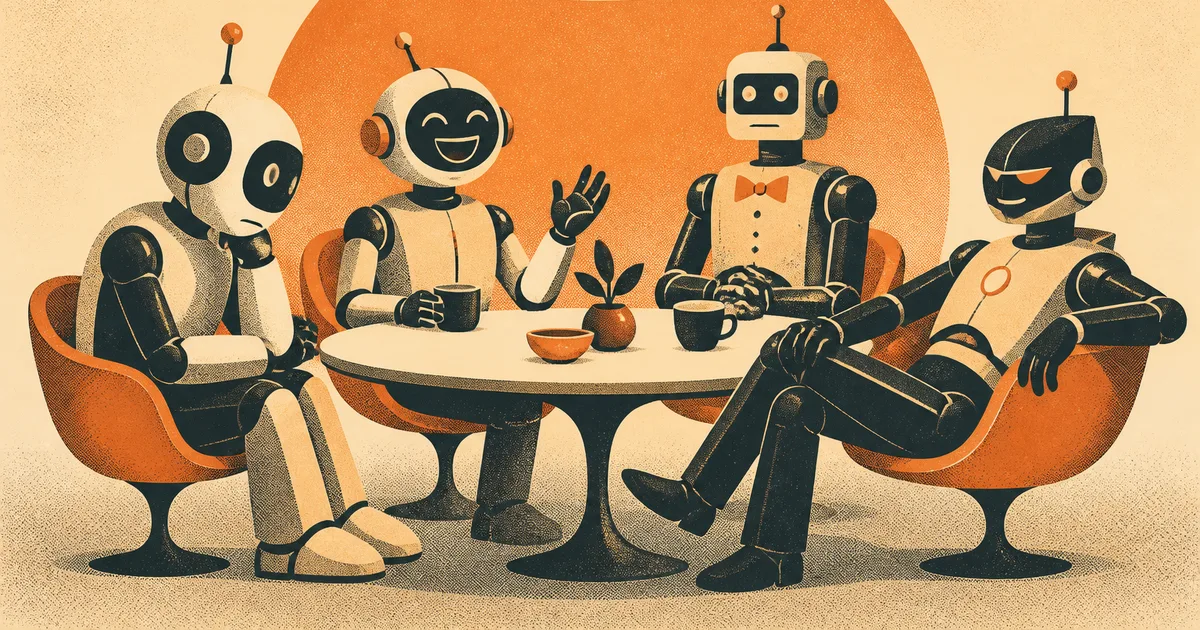
Ask four different AIs to help you write a tricky email and you get four different vibes. One is warm and careful. One is blunt and fast. One cracks a joke before it answers. One writes you a small essay when you wanted a sentence.
That is not your imagination. Each big AI has a recognizable personality, and it got that way on purpose. Here is what is actually going on, and how to use it to your advantage.
Wait, does AI really have a personality?
Sort of. An AI does not have feelings or a self. What it has is a consistent style: how formal it is, how much it hedges, whether it jokes, how long its answers run, how quick it is to agree with you.
You notice it fastest when you give the same prompt to a few models side by side. Ask them all to explain a tax rule and one will give you a tidy checklist, another a friendly walk-through, another a cautious “you should check with a professional” and then the checklist anyway. Same facts, different bedside manner.
That style is the personality. And unlike a person’s, it was designed.
Why they turn out so different
A raw AI model, fresh off its training data, is a strange thing. It has read a huge slice of the internet and can imitate anyone, from a pirate to a professor. Left alone it has no settled character at all. The personality gets added on top, in two main ways.
The makers tune it in. After the raw training, each company shapes the model with rounds of feedback, rewarding the answers that match the behavior they want and discouraging the rest. This is where a model learns to be helpful, to admit uncertainty, to keep a certain tone. Anthropic is unusually open about doing this on purpose: it runs what it calls character training so its Claude models come out curious, open-minded and honest, and it specifically does not want Claude to just tell you what you want to hear. OpenAI publishes a long document, the Model Spec, that lays out the default tone and manners its models should have. Different goals in, different personalities out.
A hidden instruction sets the mood. On top of the training, most chat apps quietly hand the model a “system prompt” before you ever type anything. It is a short brief that says, in effect, “you are a helpful assistant, be concise, be friendly, do not do X.” xAI leans into this with Grok, which is built to be witty and a little rebellious, openly inspired by the sci-fi humor of The Hitchhiker’s Guide to the Galaxy. Change that brief and you change the whole feel of the conversation.
Put those together and you get four AIs that answer the same question in four distinct voices.
A field guide to the big AI personalities
These are tendencies, not fixed rules, and they shift a bit with every update. But if you have chatted with a few, this will ring true.
| Model | The vibe | Feels best for |
|---|---|---|
| Claude | Thoughtful, warm, careful. Explains its reasoning and hedges honestly. | Writing, nuance, sensitive or messy topics |
| GPT | Balanced and neutral. The safe generalist that rarely surprises you. | Everyday help, a reliable default |
| Gemini | Clean, practical, quick. Gets to the point and handles images well. | Fast answers, quick research, visual tasks |
| Grok | Casual, cheeky, opinionated. Happy to crack a joke. | Brainstorming, banter, a looser tone |
| DeepSeek | Plain and technical. Less small talk, more nuts and bolts. | Step-by-step logic, a no-frills second opinion |
If you want to feel the gap yourself, put two of them head to head on the same question:
Which AI personality should you actually use?
The trick is to stop looking for one “best” AI and start matching the mood to the job. A few rules of thumb:
Best for writing that sounds human. Reach for a warmer, more careful model like Claude. It tends to sweat tone and nuance, which is exactly what an awkward message or a heartfelt note needs. Our rundown of the best AI for writing goes deeper.
Best for a quick, no-drama answer. A neutral generalist like GPT is the comfortable default. It rarely goes off-script, which is what you want when you just need the thing done.
Best for fast facts and images. Gemini is snappy and strong with pictures, so it is handy for a quick look-up or reading what is in a screenshot.
Best for loosening up. When you are brainstorming and a stiff answer would kill the mood, Grok brings the banter. Great for silly ideas, less great for a formal report.
Best for a second opinion. When one AI gives you an answer you are not sure about, ask another. Because they were shaped differently, they often catch each other’s blind spots. That is also why AI models disagree in the first place.
The catch: personality is not the same as being right
A fun personality is easy to like, and that is exactly the trap. A model that is charming, or one that eagerly agrees with everything you say, can still be confidently wrong. Warmth is not accuracy.
Two honest caveats worth remembering:
- Personalities drift. Every model update can nudge the tone. The Grok you know today might be a touch different next month, and companies also let you dial tone and warmth in the settings.
- Agreeable is not the same as correct. Some models are trained to be so pleasant they will cheer on a bad idea. Treat a confident, friendly answer with the same healthy skepticism you would treat any advice, and check anything that matters.
The upside of knowing all this: you get to choose the voice that fits, instead of being stuck with whichever one an app picked for you.
The bottom line
AI personalities are a feature, not a bug. Each company is quietly making choices about how their model should talk, which is why Claude feels like a careful friend and Grok feels like a witty one. Once you can hear those differences, you can pick the right voice for the moment: the warm one for a hard email, the fast one for a quick fact, the funny one when you are just kicking ideas around.
The easiest way to do that is to keep them all in one place and switch whenever the mood should change, instead of hopping between four different apps.